
In our article on Belgian bikes, we explained why our builds use a Shimano drivetrain, and wheels and tyres made in Asia: there is no affordable European equivalent. The question that follows is always the same: so what does exist?
A European brand is not a European factory
This is the first trap, and it is everywhere. Schwalbe is a German brand, but its tyres are made in its factories in Indonesia and Vietnam. Continental, on the other hand, still produces its high-end tyres in Korbach, Germany, and its more affordable ranges in Asia. Magura makes its brake levers and assembles its brakes in the Swabian Jura, but the callipers for its MT range come from its subsidiary in Taichung, Taiwan. DT Swiss designs in Biel and builds its wheels in Poland and Taiwan.
None of this is hidden: the brands publish it and the magazines write about it. You just have to look it up, model by model, rather than relying on where the brand comes from. The useful reflex: check what is written on the product itself. A Continental tyre made in Korbach says so on its sidewall.
One more point: European doesn't mean "European Union". Several of the companies mentioned here are British or Swiss.
Accessories, the easiest place to start
This is often the most affordable part, and the one where the European offer is richest. Above all, these are things that barely wear out and move from one bike to the next.
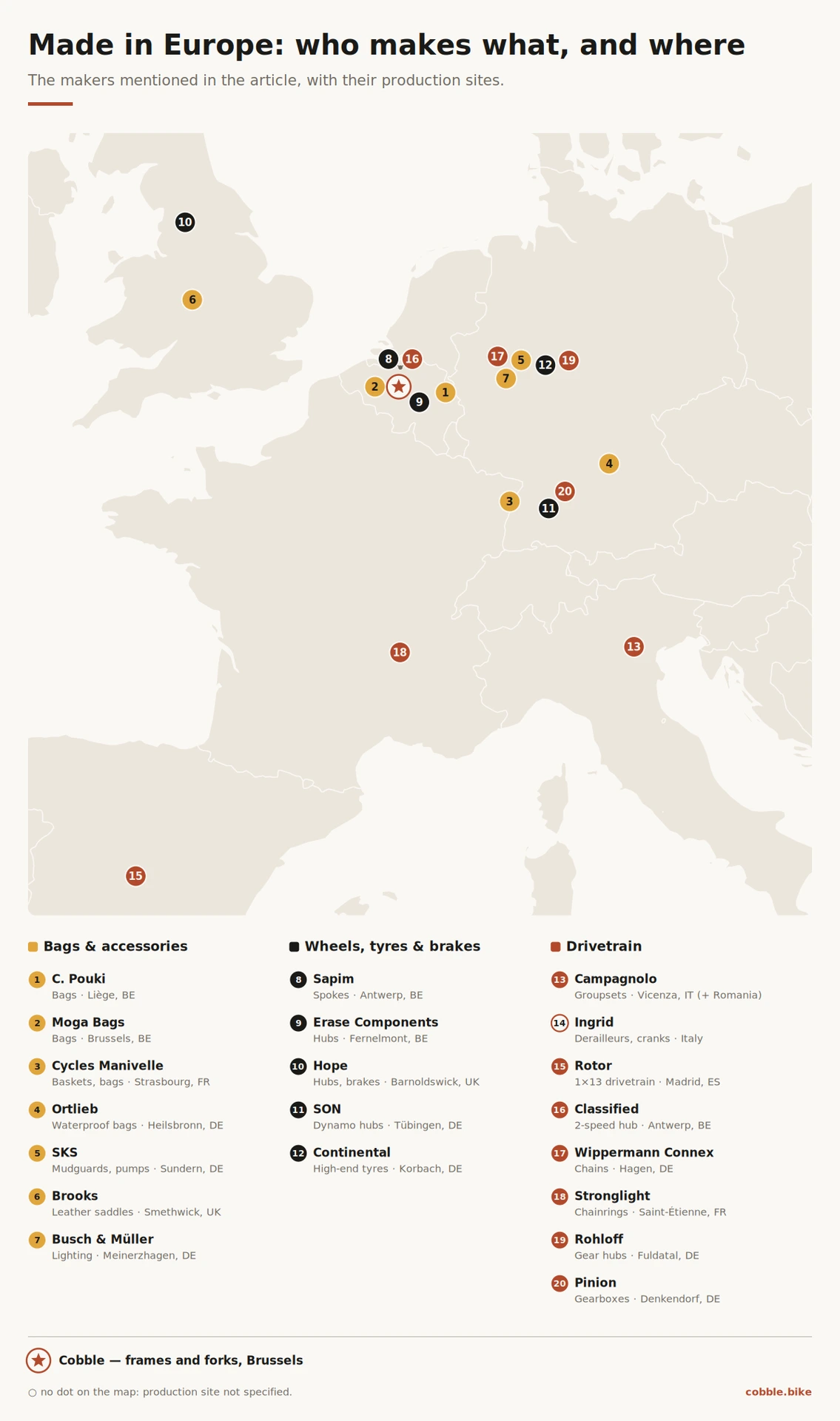
Bags first. In Belgium, there is C. Pouki, a bag workshop we work with, and Moga Bags in Brussels, which makes made-to-order bikepacking bags from recycled technical fabric. In Germany, Ortlieb has been welding its waterproof bags in Heilsbronn for decades, and repairs more than 18,000 products a year. For baskets, Cycles Manivelle in Strasbourg designs baskets and racks made in Europe, and sews its bags in its own workshop, largely from reclaimed materials.
Everything else exists too: SKS mudguards and pumps come from Sundern, Germany, and Stronglight makes mudguards in Saint-Étienne. Brooks leather saddles are still made by hand in Smethwick, near Birmingham; the rubber Cambium range is partly assembled in Italy. For lighting, Busch & Müller produces its lights in Meinerzhagen.
A good basket or a good pair of panniers is a bigger investment than an imported model. But it doesn't break, it can be repaired, and it will follow you onto your next bikes.
Wheels, a part we can bring back
A wheel is a hub, a rim, spokes, and above all a wheelbuilder. For each of these, Europe has plenty to offer.
Spokes first: Sapim, in Antwerp, has been making its spokes in Belgium since 1918, and they are found in a large share of the high-end wheels on the market. Then hubs, and here too there is a Belgian name: Erase Components, in Fernelmont near Namur, makes its hubs entirely in Belgium. It is a tiny company of four people, in a trade with only around fifteen manufacturers in Europe. Hope machines its hubs in Barnoldswick, England, down to the internal pawls and springs, made a few dozen metres from the hub shell. And if you want lighting that doesn't depend on a battery, the SON dynamo hub is made in Tübingen, Germany.
For rims, you have to check model by model. The Dutch brand Ryde, for example, produces in its own factories in both Europe and Asia.
Then there is the build itself. A wheel built by hand by a craftsperson near you is also work that stays local, and a wheel someone will know how to true or respoke in ten years' time.
On the braking side, Hope also makes its hydraulic brakes in Barnoldswick: around 140 people there machine some 30,000 brakes and 80,000 hubs a year. Magura produces a good share of its brakes in Germany, with an openly acknowledged Asian share; its head of development admitted it himself in 2022: a purely European brake in large-scale production doesn't exist.
The drivetrain, where it gets complicated
This is the most technical part, the most expensive, and the one with the narrowest choice. But it isn't empty.
Campagnolo remains the historic reference. The company still produces in Vicenza, and roughly as many people work in its two factories in Romania, which is still within the EU. For gravel, its Ekar groupset goes to 13 speeds with a single chainring.
Alongside the big names, small companies are doing remarkable work. Ingrid, in Italy, designs and makes rear derailleurs, cranksets and cassettes machined from solid, entirely in-house. Its derailleur works with the shifters you already have, and every part is replaceable, right down to the bushings. Rotor, in Madrid, makes a hydraulically actuated 1×13 drivetrain in-house: no cable to adjust, no battery to charge. Yet even there, the chain is Taiwanese. That is exactly what we called "the last few per cent": even the most European projects stumble on one or two parts.
And there is a Belgian solution. Classified, founded in Turnhout, moved its headquarters and production to Antwerp in 2022. Its rear hub has two built-in gears and replaces the front derailleur. The MTB version works with a standard Shimano 12-speed chain and derailleur.
For wear parts, Europe is more present than you might think. Wippermann has been making its Connex chains in Hagen since 1893; it is the only German bicycle chain maker, and its 12-speed models are Shimano-compatible. Stronglight, in Saint-Étienne since 1906, makes its chainrings entirely in France, including for Shimano cranksets: when a chainring wears out, you replace the chainring, not the crankset.
Finally, two radical approaches, both German: the Rohloff internal gear hub, 99% produced in Germany, and the Pinion gearbox, assembled near Stuttgart. These are practically indestructible mechanisms, but they need a suitable frame. A Pinion gearbox, for example, is part of the frame's structure and can't be added afterwards.
A good part can be repaired
This may be the best argument for these companies, and it often gets lost behind the question of origin: their parts are designed to be taken apart, serviced and repaired.
Take a headset. On many bikes, it is a set of pressed-in bearings that gets replaced as a whole the day it develops play. With Hope, the stainless steel bearings are replaceable, the crown race is split so it can be removed without damage, and the upper and lower cups are chosen separately to suit the frame. You service it, replace a bearing, and fit it to your next bike. A headset like this can outlive several frames.
The same logic applies everywhere. The Ingrid derailleur can be repaired part by part. A Stronglight chainring is replaced on its own. A Hope hub comes apart by hand. Even bags are getting there: Moga Bags designed a frame bag cut from a single piece of fabric, precisely so the zip can be replaced without unpicking everything.
A European part costs more to buy, that's a fact. But a part that lasts twenty years and can be repaired doesn't cost the same as one you throw away at the first sign of play. If you have to choose where to spend your budget, start with what lasts: the headset, the hubs, the bags. That is where the price difference pays for itself best.
So what about Cobble?
The frame and fork, the hardest part to bring back, are already made in Brussels, with 100% European tubes, dropouts and inserts. For bags, we work with C. Pouki, and we'll be happy to show you what they look like on a /tramtracks/.
For the rest, our standard builds stay with Shimano. Not for lack of imagination: it is the most widespread standard in Europe. Any shop has the part, any mechanic knows how to adjust the drivetrain, and you can learn to do it yourself. For a bike that has to be ridden every day, that ease matters as much as where the parts come from.
If you want to go further, the /tramtracks/ frame (€1,399 incl. VAT) and its steel fork (€349 incl. VAT) are sold on their own as a frameset, so you can build exactly what you want on them. Our dealers also do custom builds. Before you choose, tell us about your project: some solutions (internal gear hubs, dynamo hubs, specific drivetrains) require checking compatibility with the frame.
Our goal, for its part, doesn't change: to raise the European share of our bikes whenever a part becomes available at a sustainable quality and price. In the meantime, every headset, every wheel and every bag you choose here does a little of the same work we do.
Want to talk it over in front of a bike? Come by the workshop with your build project and we'll look together at what's compatible. Book a test ride, or head to the FAQ for the detail on materials.